
Spins
How spins and the pity counter work in Untitled Boxing Game: every free spin source, the 100-spin Legendary guarantee, Lucky Spins and how pinning changes your odds.
Introduction
Spins are the only way to change your fighting style in Untitled Boxing Game, and understanding the machinery behind them is worth more than any single pull. Styles are drawn from four rarity pools, a pity counter guarantees a Legendary once it fills, Lucky Spins improve the high-rarity odds, and a pinning system lets you tilt the odds toward one specific Legendary before you roll. Free Spins arrive from quests, daily login streaks, codes, the post-match roll and rank-up rewards; the paid route costs 2,000 Cash per spin, which makes the spin price the reference point for every other purchase in the game. This section explains how the counter behaves when you get lucky early, what Lucky Spins change and what they do not, and how to plan a session so a batch of spins converts into a guaranteed outcome rather than a scatter of low-rarity pulls.
Every Free Spin Source in UBG
| Source | Typical Yield | How It Works | Best Use |
|---|---|---|---|
| Quest rewards | 1 to 3 Spins | Objective-based quests that reset on their own cycle | The steadiest free income; clear them before a spin session |
| Redeem codes | 1 to 15 Spins | Codes from the official game page, one redemption per account | The largest single injections, especially after an update |
| Daily login streaks | 1 Spin per milestone | Logging in on consecutive days builds toward a streak reward | Cheap to maintain and easy to break by missing a day |
| Post-match roll | Occasional Spin or crate | Every completed match rolls for a bonus, including Lucky Crates | Why volume of fights matters more than style rarity early |
| Rank-up rewards | 3 to 50 Spins | Paid at each rank tier boundary from Bronze through Champion | The biggest non-code source; fifty Spins at Champion alone |
| Cash purchase | 1 Spin per 2,000 Cash | Buy directly with in-game Cash earned from matches | The fallback once free sources are exhausted |
| Lucky Spins | Event and code rewards | Improved high-rarity odds stacked on top of the pity counter | Save them for a session where you are already near pity |
Spin Economy
Pity Counter
The guarantee that anchors the whole system
Lucky Spins
Better odds rather than a free Legendary
Pinning
Targeting one Legendary before you roll
Cash and Robux
The paid route and its exchange rate
Quest Rewards
The steadiest free Spin income
Redeem Codes
The largest single injections
Post-Match Roll
Why fight volume matters early
Core Mechanics
The spin system has three moving parts that are frequently confused with each other. The pity counter is deterministic: it counts spins since your last Legendary and guarantees one at the hundred and first, which means it behaves the same for every player regardless of luck. Lucky Spins are probabilistic: they improve the odds of high-rarity outcomes within a roll but do not touch the counter, so they accelerate the value of a session without changing its endpoint. Pinning is targeted: it raises one specific Legendary's personal drop rate well above the base, which only matters during a roll that was already going to produce a Legendary. Understanding that split is what turns spin sessions from gambling into planning. A player near pity with a batch of Lucky Spins and a pinned target is running a controlled sequence, whereas a player spending three spins at low pity on a whim is simply paying for variance. The Cash price of 2,000 per spin is also the anchor for every economic decision elsewhere, because crates, style slots and trading all compete against that number.
Advantages
The pitied gacha is genuinely generous by the standards of Roblox rarity systems, because a hundred spins is an achievable target rather than a theoretical one. Between codes, rank rewards and quests, a consistently active player accumulates Spins quickly enough to hit pity without spending Robux, and the rank ladder alone pays out over a hundred Spins across its five tiers. Lucky Spins add a second lever that stacks with the guarantee instead of resetting it, which means event rewards compound rather than conflict. Pinning gives players a targeting mechanism that most games of this type do not offer at all, and the three percent rate on a chosen Legendary is a meaningful improvement rather than a token gesture. On top of that, the entire system is legible: the counter is visible, the price is fixed, and every source of free Spins is documented, so a player can plan a session rather than hope for one.
Challenges
Two design choices make the spin system harsher than its headline suggests. The first is that an early Legendary resets the pity counter, which means good luck is actively punished — a player who pulls a Legendary on spin twenty loses eighty spins of accumulated guarantee and may wait far longer for their next one than a less lucky player would. The second is that rarity does not track power closely. Several high-rarity styles sit mid-tier while cheaper styles remain competitive, so the reward for reaching pity can feel underwhelming. Drop rates for individual styles are also community estimates rather than published figures, and the newest Legendary typically ships without confirmed mechanics, which makes target pinning a speculative exercise when the newest release is the one you want. Finally, the 2,000 Cash price is high enough that crates, slots and spins genuinely compete for the same balance.
Frequently Asked Questions
How exactly does the pity counter reset?+
Do Lucky Spins change the pity counter?+
Is pinning worth using on every session?+
Quick Tips
Spend spins in batches, not one at a time. The pity counter only pays out at the hundred and first spin, so scattered rolling at low counts produces the same low-rarity outcomes as a planned session while making the guarantee feel unreachable and encouraging impulse purchases. Batching also makes it obvious how close you actually are, instead of leaving the counter feeling permanently out of reach.
Save Lucky Spins until your pity counter is high, then spend them together with your regular Spins. They do not move the counter, so their only real value is compressing the rolls before a guarantee into a smaller number of attempts with better odds per roll. At high pity they shorten the gap to a guaranteed Legendary while adding a second chance at an early high-rarity pull.
Treat the 2,000 Cash spin price as your reference number for every other purchase. Crates at 3,000, style slots and trading all compete for the same balance, and comparing them against the spin price is the fastest way to see which purchases actually advance your roster. That comparison shows which purchases actually move your roster and which ones only change how your boxer looks.
Featured
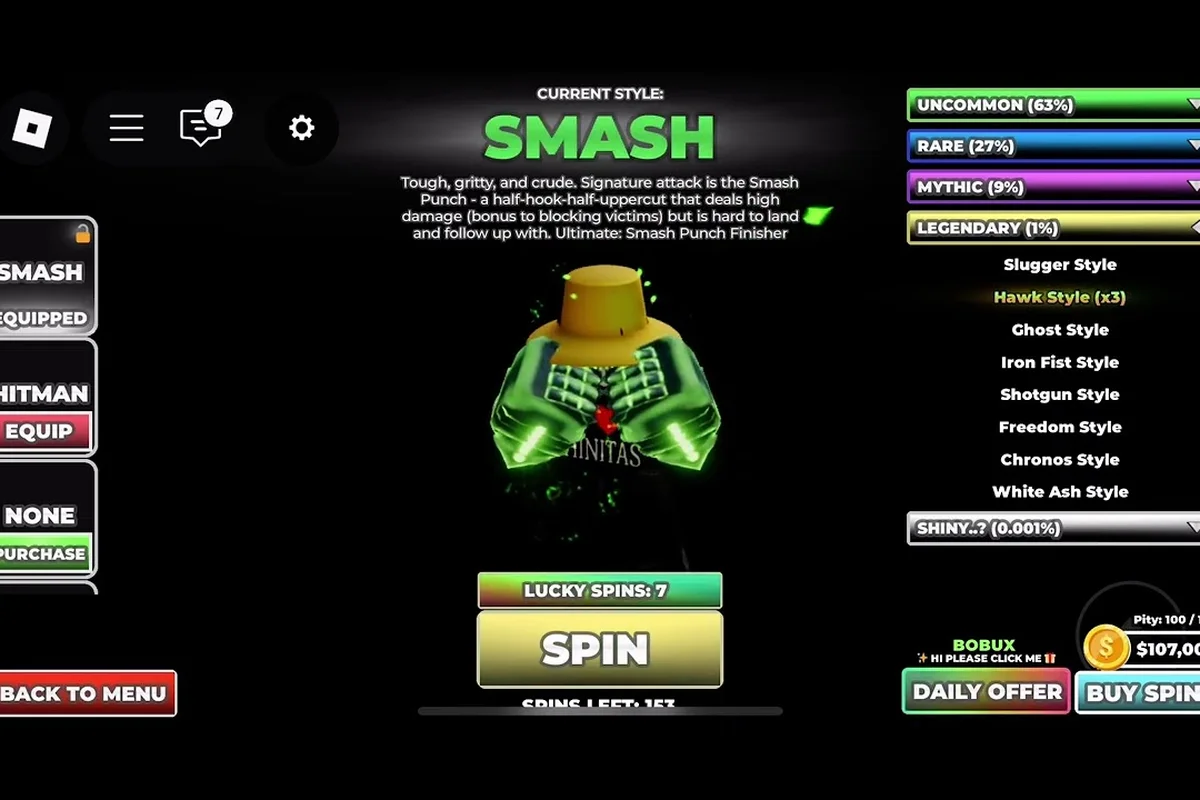
Untitled Boxing Game How to Get Spins: Free & Fast
Learn how to get spins in Untitled Boxing Game, track the pity counter for free Lucky Spins, and stack drop-rate boosts to pull legendary styles faster.
Untitled Boxing Game Multi Spin: Costs & Best Timing
Plan the best multi-spin strategy in Untitled Boxing Game with the emote spin list, Robux cost breakdown, and an odds calculator to time legendary pulls.
Untitled Boxing Game Spin Luck: Farm Routes & Boosts
Boost your Untitled Boxing Game spin luck by farming quests, stacking extra style slots, and using the spin simulator to chase legendary pulls at the best moment.
All Articles
Untitled Boxing Game Style Slot Gamepass: Is It Worth?
Decide if the Untitled Boxing Game style slot gamepass is worth buying, with slot unlock details, the 2x luck boost, and spin reset value explained.

Untitled Boxing Game Spin Machine: Sources & Spin Value
Explore the untitled boxing game spin machine, its animation quirks, daily and quest spin sources, and whether the Faster Spins pass pays off in Robux value.
Untitled Boxing Game Style Drop Rate & Pin Guide
Break down the Untitled Boxing Game style drop rate, compare legendary chances, learn the pin mechanic, and price every spin before chasing a rare pull.